Since it is the end of the year, I will not at this point be able to use "The Conversation Game" in the way I would like to. It appears to be very useful in helping students generate ideas, and showing them that ideas for art can come from all of life. Ideally, we would play this game at least four times throughout the semester, and students would also use their sketchbook and journal entries to build up a collection of ideas from which they can draw (no pun intended).
My seventh graders played the game this morning. They enjoyed it very much, and I wasn't surprised. Of course, I don't know of many middle school students that wouldn't enjoy a game centered on talking with other students. Instead of verbally sharing the questions with each other at the end, they wrote them on the board. Here are some of the questions they wrote:
"If you could change your name, what would it be?"
"Where is your favorite campsite?"
"What is your favorite sport, and why?"
"What are you going to do over the summer?"
"If you could live in any time period, what would it be?"
Although I had an overall positive response from my students, and they came up with creative questions and answers which could easily contribute toward artistic inspiration in the future, I am not sure how well this works as a game. Our game this morning ended in a tie, since no two groups came up with the same question. At this point, I would like to try to add an element to this game.
Thursday, May 29, 2008

Some Thoughts on "The Conversation Game"
While writing a new art curriculum, in search of a way for my students to explore where artists get their ideas, I came upon “The Conversation Game,” which was developed by Marvin Bartel, Ed. D. Follow this link to see the lesson: http://www.goshen.edu/art/ed/self.html In the article accompanying the lesson, he wrote about one of his biggest challenges as a teacher:
“I had a problem. I was good at teaching skills, but teaching technicians was not enough. My teaching needed to find ways to communicate this autobiographical nature of art to students in a way that made their own mind, soul, experience, and values available to them and more important to them. Just assigning this was not enough to see it happen. I know there are those who say art cannot be taught, but that did not keep me from trying.”
I have been wondering how I could inspire my students and teach them to get excited about coming up with their own ideas. It sounded to me like this teacher was on the same wavelength. One focus that I have found to be particularly helpful in area is getting students to ask questions. I have mostly explored different ways of getting students to ask questions about artwork. However, the goal of the Conversation Game is to get students to ask questions about each other.
“When students practice the ability to form questions, they are exercising their critical thinking abilities and skills. Learning to ask good questions is learning critical and artistic thinking habits.” Until reading this article, I have been thinking of art as a catalyst for asking questions, not the other way around. Although I have heard artists refer to their artwork as being explorations of ideas and concepts, I hadn’t thought about the fact that this was necessarily advantageous to the artist.
Dr. Bartel stresses the fact that artistic ideas come from all of life, and they come when you least expect it. Part of coming up with great ideas is learning to take a real interest in life, and a great place to start is taking interest in the lives of others. Central to this game is asking questions about other students’ lives, and points are awarded for coming up with the most original questions. I think this approach to teaching creative thinking would be successful, since students might not be as prone to getting bogged down by a supposed need to come up with some grand idea out of thin air. It shows them in a very practical way how one idea can lead to another, and how great ideas start from talking, thinking about, and living everyday life. I also like the fact that it helps the students think outside of their own world, and become interested in someone else’s. This is something that I think we especially need to strive to teach at the middle school level. I am going to use this lesson today with my 6th and 7th grade classes, and am excited to see how it works out. In the future, I intend to use this toward the beginning of the school year.
“I had a problem. I was good at teaching skills, but teaching technicians was not enough. My teaching needed to find ways to communicate this autobiographical nature of art to students in a way that made their own mind, soul, experience, and values available to them and more important to them. Just assigning this was not enough to see it happen. I know there are those who say art cannot be taught, but that did not keep me from trying.”
I have been wondering how I could inspire my students and teach them to get excited about coming up with their own ideas. It sounded to me like this teacher was on the same wavelength. One focus that I have found to be particularly helpful in area is getting students to ask questions. I have mostly explored different ways of getting students to ask questions about artwork. However, the goal of the Conversation Game is to get students to ask questions about each other.
“When students practice the ability to form questions, they are exercising their critical thinking abilities and skills. Learning to ask good questions is learning critical and artistic thinking habits.” Until reading this article, I have been thinking of art as a catalyst for asking questions, not the other way around. Although I have heard artists refer to their artwork as being explorations of ideas and concepts, I hadn’t thought about the fact that this was necessarily advantageous to the artist.
Dr. Bartel stresses the fact that artistic ideas come from all of life, and they come when you least expect it. Part of coming up with great ideas is learning to take a real interest in life, and a great place to start is taking interest in the lives of others. Central to this game is asking questions about other students’ lives, and points are awarded for coming up with the most original questions. I think this approach to teaching creative thinking would be successful, since students might not be as prone to getting bogged down by a supposed need to come up with some grand idea out of thin air. It shows them in a very practical way how one idea can lead to another, and how great ideas start from talking, thinking about, and living everyday life. I also like the fact that it helps the students think outside of their own world, and become interested in someone else’s. This is something that I think we especially need to strive to teach at the middle school level. I am going to use this lesson today with my 6th and 7th grade classes, and am excited to see how it works out. In the future, I intend to use this toward the beginning of the school year.
Monday, April 28, 2008
Regular Contour Drawings
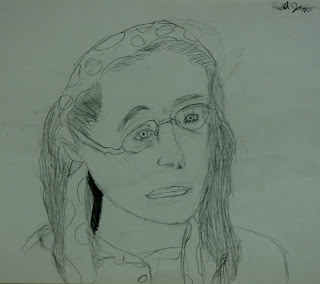
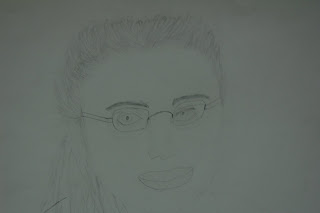
These are some regular contour drawings my students did a couple of weeks ago. Although some of them really enjoyed blind contour drawing, most students let out a sigh of relief when I told them they didn't have to draw with a shield over their hand. I think the blind contour drawing helped them to draw more of what they actually saw, rather than what they thought they saw--even when they were allowed to look at their paper (I did stress, however, that they should be looking at their subject 90% of the time).


Friday, April 25, 2008
Letter to An Artist
Yesterday, each of my students picked an art print from our classroom print collection and wrote a letter to the artist of the painting reproduced.
Here are a few of their letters:
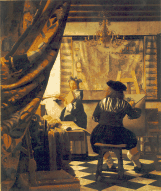
Dear Johannes Vermeer,
I love your painting! The colors brown and red sit very well together. Is that supposed to be you painting in the picture?
I think the way you put such a detailed picture in the background is an awesome idea! Was this back when Spain still hadn’t found America? I think that your painting of another painting was a brilliant idea!
Sincerely,
Jasmine
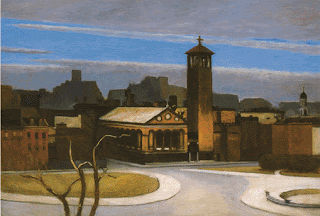
Dear Mr. Hopper,
I love your work (November, Washington Square). It is a very realistic looking picture. I like how it shows real American life at that time.
This picture is of a city so you should do one of the country out west. I also like how the sky is painted with the blue in the middle. I think you are great at painting cities.
Sincerely,
Carrie
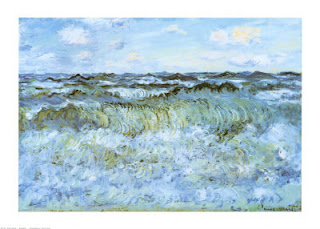
Dear Mr. Monet,
Why did you choose all those bluish colors? Were you sad about someone dying at sea? I like the colors you chose for this particular painting.
Were you angry when you painted this? All of your strokes look like they were done in anger, or in a rush. Get back to me on that, okay?
Sincerely,
Rachel
Here are a few of their letters:

Dear Johannes Vermeer,
I love your painting! The colors brown and red sit very well together. Is that supposed to be you painting in the picture?
I think the way you put such a detailed picture in the background is an awesome idea! Was this back when Spain still hadn’t found America? I think that your painting of another painting was a brilliant idea!
Sincerely,
Jasmine

Dear Mr. Hopper,
I love your work (November, Washington Square). It is a very realistic looking picture. I like how it shows real American life at that time.
This picture is of a city so you should do one of the country out west. I also like how the sky is painted with the blue in the middle. I think you are great at painting cities.
Sincerely,
Carrie

Dear Mr. Monet,
Why did you choose all those bluish colors? Were you sad about someone dying at sea? I like the colors you chose for this particular painting.
Were you angry when you painted this? All of your strokes look like they were done in anger, or in a rush. Get back to me on that, okay?
Sincerely,
Rachel
Monday, April 21, 2008


Reflections on Teaching Creative Thinking
As I have read further on creative thinking, two characteristics of creative thinkers that have particularly struck me as interesting are: “a desire to work hard and at the edge of one’s abilities and knowledge” and “a belief in doing something well for the sake of personal pride and integrity.” Both of these characteristics are taken from a list developed by Dr. Craig Roland, referring to studies done by T.M. Amabile and D.N. Perkins in the 1980s. I wonder if these two attributes are necessary in order for a student to have the patience to show other traits on this list, such as:
• a willingness to drop unproductive ideas and temporarily set aside stubborn problems
• a willingness to persist in the face of complexity, difficulty or uncertainty
• a willingness to take risks and expose oneself to failure or criticism
• a desire to do something because it’s interesting or personally challenging to pursue
• an ability to concentrate effort and attention for long periods of time
I have always considered the drive to work hard and learn new skills and information, simply for the pleasure of doing so, to be something that people are born with—some to a greater extent than others. As I have worked in the arts, it has also been very apparent to me that doing something well is very satisfying, whether or not anyone else notices.
How, as an art educator, can I help my students to develop these attitudes? It sometimes feels like when I'm trying to do so I am swimming upstream in a culture that seems to teach kids to need instant gratification, a numerical score for so much of their work, and incentives for doing day-to-day tasks. External motivation is all over the place, and as a result, students seem to expect us to reward them every time they stretch themselves in some way. I also think our schedule-oriented society teaches kids that ‘faster is better.’ There are so many times that I feel like my students are racing against the clock to get their work done, and I struggle with getting them to slow down and really take their time on what they are doing.
One suggestion I have read—and tried—is to give students activities that they find intrinsically motivating. Activities that give students many opportunities to make their own decisions are encouraged. This gives the students more of a sense of ownership about their work.
However, there are some students in my classes who do naturally take their time on every single project, careful to produce pleasing results. For these students, it does not matter what the assignment is, or how many decisions they were allowed to make. These students encourage me, but they also challenge me. Why is it that some students exhibit this tendency so much more consistently than others, regardless of the assignment? Shouldn’t I be able to help all of my students develop such an intrinsic desire to work for a long time in order to achieve high quality work?
At this point, one thing I can focus on is breaking projects down into a series of defined steps. Lately, I have required my students to brainstorm ideas on paper before even starting to draw, using tools such as a web chart. This year I have very often required my students to make sketches before working on a final piece--something that I did not do in my earlier years of teaching. I am also realizing the importance of verbally emphasizing how carefully and slowly I like to work while giving demonstrations in class, hoping students will model this when they engage in their activities.
These are small steps toward what seems to me to be very important goals. They are external, and I can only hope that they will affect my students internally. It is my view that developing desires for quality and intellectual growth within students is key to promoting creative thinking.
• a willingness to drop unproductive ideas and temporarily set aside stubborn problems
• a willingness to persist in the face of complexity, difficulty or uncertainty
• a willingness to take risks and expose oneself to failure or criticism
• a desire to do something because it’s interesting or personally challenging to pursue
• an ability to concentrate effort and attention for long periods of time
I have always considered the drive to work hard and learn new skills and information, simply for the pleasure of doing so, to be something that people are born with—some to a greater extent than others. As I have worked in the arts, it has also been very apparent to me that doing something well is very satisfying, whether or not anyone else notices.
How, as an art educator, can I help my students to develop these attitudes? It sometimes feels like when I'm trying to do so I am swimming upstream in a culture that seems to teach kids to need instant gratification, a numerical score for so much of their work, and incentives for doing day-to-day tasks. External motivation is all over the place, and as a result, students seem to expect us to reward them every time they stretch themselves in some way. I also think our schedule-oriented society teaches kids that ‘faster is better.’ There are so many times that I feel like my students are racing against the clock to get their work done, and I struggle with getting them to slow down and really take their time on what they are doing.
One suggestion I have read—and tried—is to give students activities that they find intrinsically motivating. Activities that give students many opportunities to make their own decisions are encouraged. This gives the students more of a sense of ownership about their work.
However, there are some students in my classes who do naturally take their time on every single project, careful to produce pleasing results. For these students, it does not matter what the assignment is, or how many decisions they were allowed to make. These students encourage me, but they also challenge me. Why is it that some students exhibit this tendency so much more consistently than others, regardless of the assignment? Shouldn’t I be able to help all of my students develop such an intrinsic desire to work for a long time in order to achieve high quality work?
At this point, one thing I can focus on is breaking projects down into a series of defined steps. Lately, I have required my students to brainstorm ideas on paper before even starting to draw, using tools such as a web chart. This year I have very often required my students to make sketches before working on a final piece--something that I did not do in my earlier years of teaching. I am also realizing the importance of verbally emphasizing how carefully and slowly I like to work while giving demonstrations in class, hoping students will model this when they engage in their activities.
These are small steps toward what seems to me to be very important goals. They are external, and I can only hope that they will affect my students internally. It is my view that developing desires for quality and intellectual growth within students is key to promoting creative thinking.
Thursday, April 17, 2008
Turning Curriculum Around
The idea of the ‘Backward’ Curriculum Design Process is a new one to me, even though I’ve been in the field of teaching for several years. An article I read recently on the subject pointed out that many teachers focus on what they are teaching more than what the students are actually taking away with them. They are concerned first with things like materials and what activities the students will do rather than the learning goals. Unfortunately, this reminds me of the way I am used to planning my curriculum.
To me, music and art (at first glance) seem to revolve around activities. In teaching these, my main goal has often been merely to engage my students and help them to improve on a particular skill. This article describes much of what has gone on in traditional design to be ‘hands-on’ rather than ‘minds-on.’ I think a fair amount of my teaching has encouraged my students to actively apply their minds to what they are doing, in order to produce desired results. ‘Big ideas,’ those universal truths which are relevant across the ages, in multiple disciplines, were pleasant highlights that my students and I would happen upon along the journey. However, for most of my teaching career, I don’t think they have necessarily been the focus of my teaching.
Studies have shown that children are prone to look for reason and intentionality behind most things. I especially have noticed this attribute while teaching adolescents. Students’ questioning about the reason behind activity is a good thing, and since much of my teaching has been activity based, I have not often enough used it to my advantage. I have thought it difficult to deal with while teaching students a skill I consider to be intrinsically valuable (especially when they do not at first agree with me). However, it should be something I actively embrace and encourage. Building connections among universal truths and all of the skills I wish to teach in art is a large challenge, but one well worth pursuing. I am realizing more and more that I need to use the universal truths as scaffolding rather than ornamentation.
I am wondering if a large hurdle for me will be picking a new starting point. For example, I deem skills necessary for good representational drawing to be important. I would like to be assured that my students are taught the basic principles of this and other disciplines that fall into the category of visual arts. Focusing on the practical aspects of my discipline seems to be more challenging when I am starting with universal truths. However, his is a challenge I am definitely willing to take on, as I see that it is the universal truths that hold a curriculum together, connect it with other disciplines, and ultimately show the students that it is relevant to life.
To me, music and art (at first glance) seem to revolve around activities. In teaching these, my main goal has often been merely to engage my students and help them to improve on a particular skill. This article describes much of what has gone on in traditional design to be ‘hands-on’ rather than ‘minds-on.’ I think a fair amount of my teaching has encouraged my students to actively apply their minds to what they are doing, in order to produce desired results. ‘Big ideas,’ those universal truths which are relevant across the ages, in multiple disciplines, were pleasant highlights that my students and I would happen upon along the journey. However, for most of my teaching career, I don’t think they have necessarily been the focus of my teaching.
Studies have shown that children are prone to look for reason and intentionality behind most things. I especially have noticed this attribute while teaching adolescents. Students’ questioning about the reason behind activity is a good thing, and since much of my teaching has been activity based, I have not often enough used it to my advantage. I have thought it difficult to deal with while teaching students a skill I consider to be intrinsically valuable (especially when they do not at first agree with me). However, it should be something I actively embrace and encourage. Building connections among universal truths and all of the skills I wish to teach in art is a large challenge, but one well worth pursuing. I am realizing more and more that I need to use the universal truths as scaffolding rather than ornamentation.
I am wondering if a large hurdle for me will be picking a new starting point. For example, I deem skills necessary for good representational drawing to be important. I would like to be assured that my students are taught the basic principles of this and other disciplines that fall into the category of visual arts. Focusing on the practical aspects of my discipline seems to be more challenging when I am starting with universal truths. However, his is a challenge I am definitely willing to take on, as I see that it is the universal truths that hold a curriculum together, connect it with other disciplines, and ultimately show the students that it is relevant to life.
Subscribe to:
Posts (Atom)
